


In today’s challenging environment it is critical for companies to attract, develop and retain the right talent to ensure the sustainability of the business. Current events in the world show that it will be even tougher in future and to ensure growth companies will have to ensure excellence in all aspects. An important element of excellence is competent people. Technical skills form the basis of competence, but work-place experience, practical implementation of theory and a broader knowledge of the business are crucial to ensure that employees are able to make a positive contribution. Mentoring is a key element in ensuring that talent is engaged and committed and therefore less likely to leave the company. It has also been linked conclusively to increased performance.
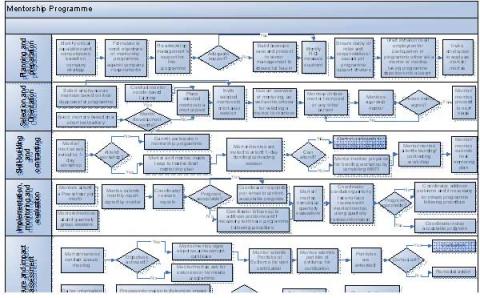
The following high-level process can assist in ensuring that any formal mentorship programme runs smoothly:
For the Bonding/Contracting session in Phase 3 LeMaSa has designed a unique workshop based on discovery learning. Discovery learning is an inquiry-based, constructivist learning theory that takes place in problem solving situations where the learner draws on his or her own past experience and existing knowledge to discover facts and relationships and new truths to be learned. Learners interact with the world by exploring and manipulating objects, wrestling with questions and controversies, or performing experiments. As a result, learners may be more likely to remember concepts and knowledge discovered on their own. Discovery learning has many advantages, including - encourages active engagement; promotes motivation; promotes autonomy, responsibility, independence and the development of creativity and problem solving skills; it is a tailored learning experience.
LeMaSa has developed a Mentoring Game™ that involves the mentor-mentee pairs competing with each other during the workshop day. The game entails ten (10) tasks, for example: Building a tower; Getting to know each other’s preferences (based on MBTI) and the impact on our relationship; Building our vision for the mentoring relationship; Clarifying the roles and responsibilities of the mentor/mentee; Identifying potential obstacles and how to deal with them; Trust building; Designing a feedback structure; Building a roadmap with milestones; Communication task. This will enhance any formal mentorship programme!


